
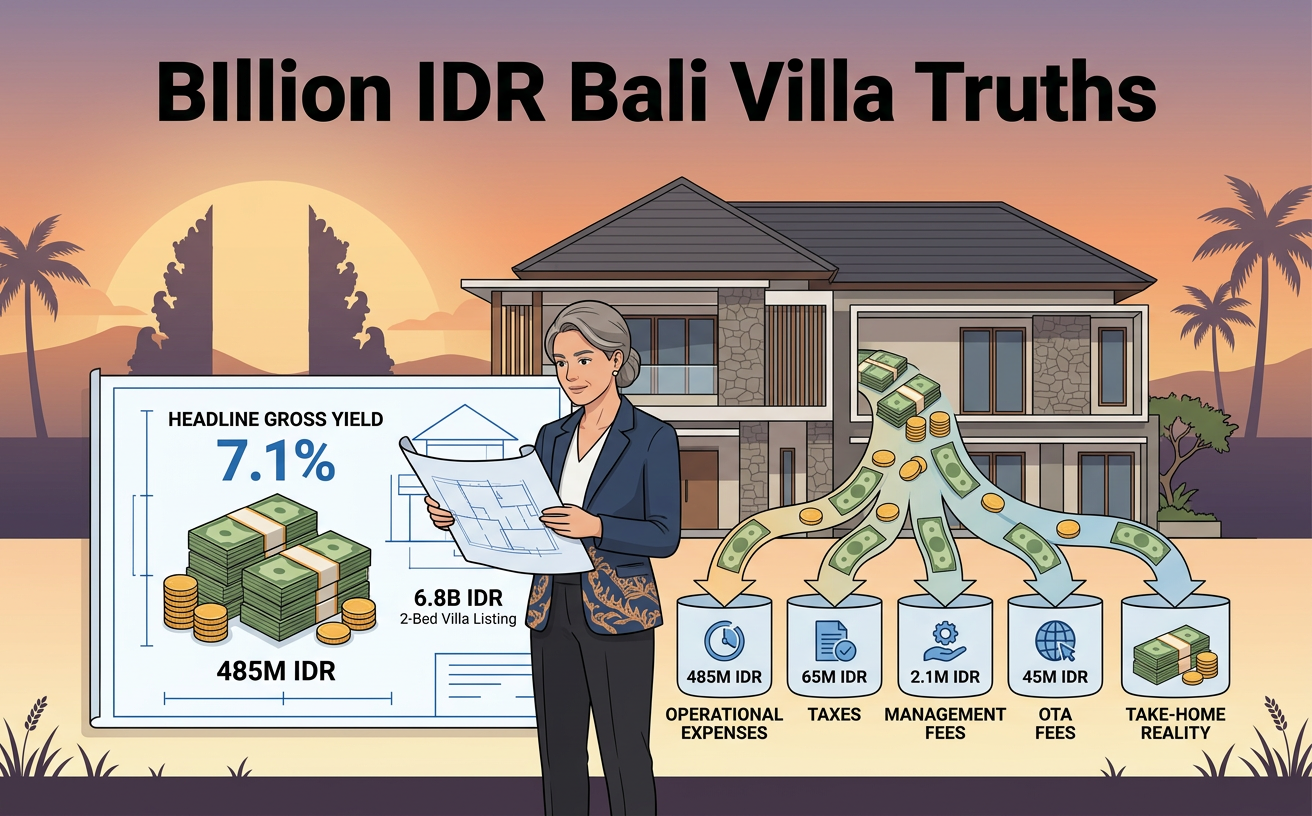
We are unpacking content from Bali Business Review on YouTube to examine a 6.8 billion IDR listing for a 2-bedroom villa that projects a 7.1% gross yield (roughly 485M IDR annually). This report focuses on the measurable gap between headline gross revenue and realistic investor take-home earnings after operational expenses, taxes, management and OTA fees. Primary data points include the headline yield, sample annual revenue, and categories of deductions that typically halve perceived returns in today’s macro environment.
Hi, I’m Jason, a Business Journalist at Bukit Vista, and I’ll be unpacking analysis from Bali Business Review. Today, we’ll dive into the economics of a 6.8B IDR Bali villa investment to offer clear, data-driven insights.
Gross Yield vs Net Yield: Where the Headline Numbers Fall Short
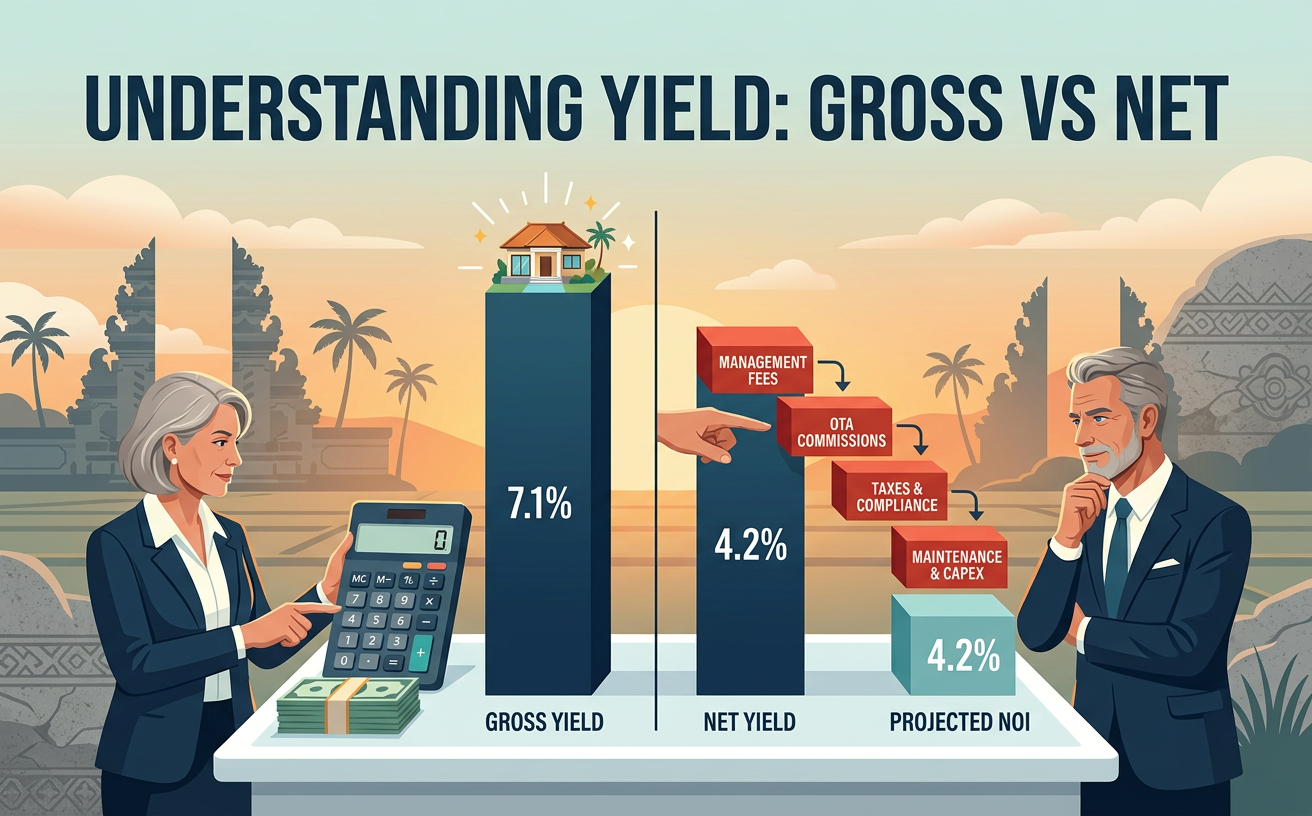
The headline 7.1% gross yield on a 6.8B IDR two-bedroom villa translates to about 485M IDR in annual revenue on paper. Gross yield captures top-line income but ignores nearly all recurring costs that owners must pay to generate and sustain that revenue. This creates a persistent illusion: properties that look profitable at first glance often deliver materially lower net returns once realistic expense assumptions are applied.
Investors should treat gross yield as an entry point for deeper analysis rather than a final metric. A proper comparison requires converting gross revenue into a projected net operating income (NOI) and then into a true investor yield after financing, tax, and capex reserves. The difference between gross and net is not a fixed number — it depends on management strategy, local tax treatment, and guest acquisition costs in each market.
Key factors that reduce headline yield
- Management and operations fees (on-site staff, cleaning, administration)
- Distribution and OTA commissions (platform fees and direct booking breakage)
- Taxes, insurance, and regulatory compliance costs
- Maintenance, utilities, and periodic capital expenditures
Breaking Down Typical Costs: How 485M IDR Can Shrink Fast
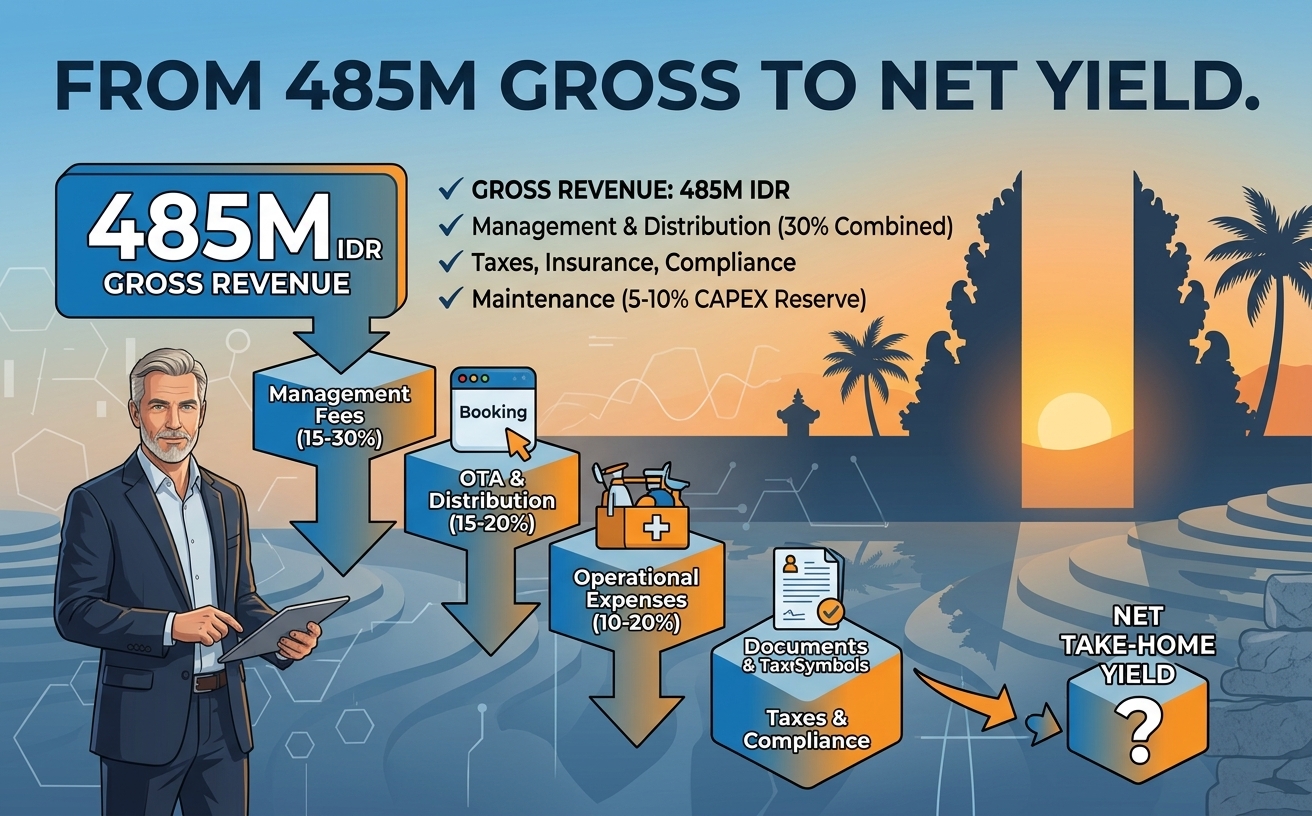
Using the 485M IDR gross figure as a baseline, common deductions can quickly erode expected returns. Management fees alone commonly range from 15% to 30% of revenue for full-service arrangements; OTA commissions and distribution costs add another 15% to 20% depending on channel mix. Operational line items — housekeeping, guest supplies, utilities, and routine maintenance — can aggregate to another 10% to 20% of revenue, depending on property standard and occupancy profile.
Taxes and local regulatory charges represent a final layer of unavoidable cost and vary by ownership structure and residency status. Taken together, these typical deductions can reduce a 7.1% gross yield into a mid-single-digit or low-single-digit net yield unless actively managed. The practical implication for buyers: build conservative expense assumptions into any yield projection and stress-test scenarios for lower occupancy and higher input costs.
Checklist to estimate net take-home yield
- Start with annual gross revenue: 485M IDR in this case
- Subtract management and distribution fees (estimate 30% combined)
- Account for taxes, insurance and compliance (variable by structure)
- Reserve for maintenance, utilities and periodic capex (5–10%+)
Why a Professional Appraisal and Business Plan Matters
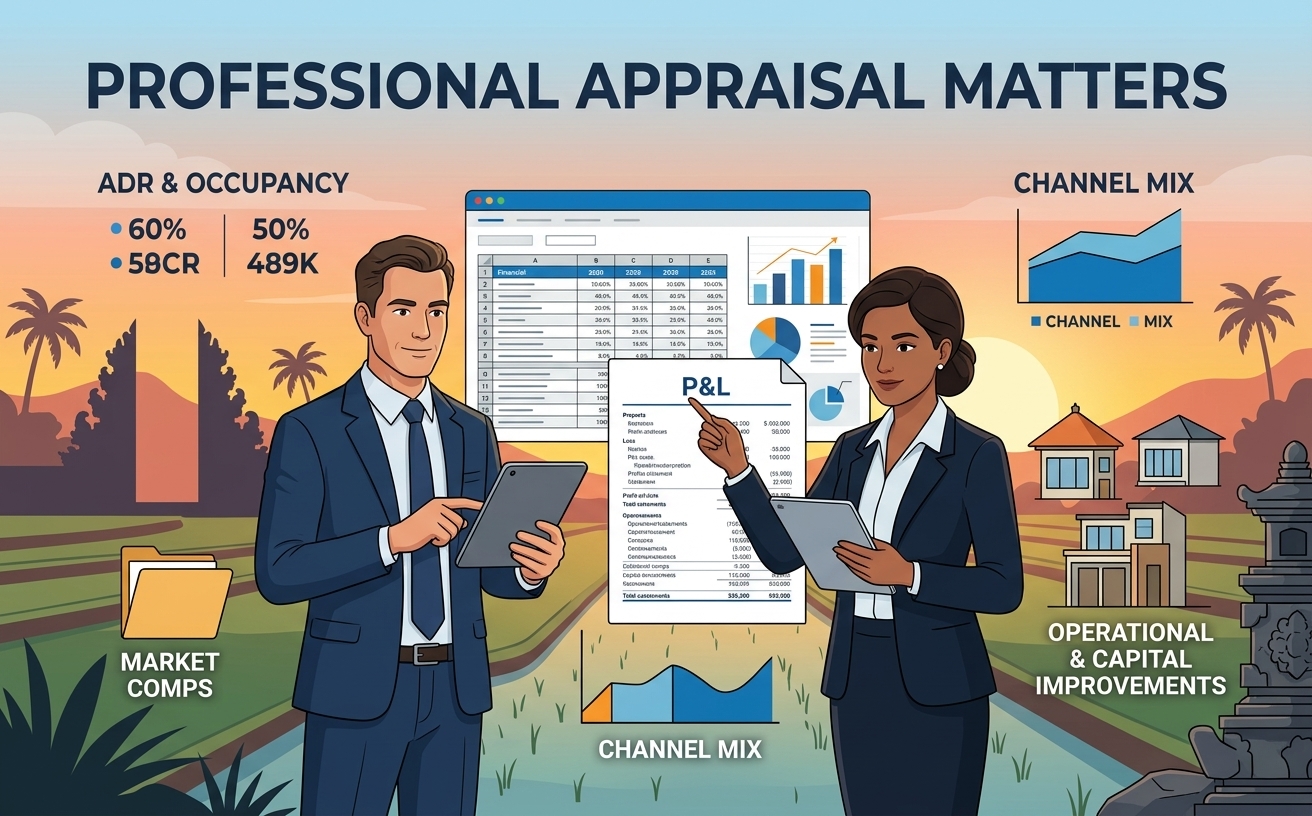
Generic yield assumptions are insufficient for investment-grade decision-making; a professional appraisal provides market-validated occupancy, ADR (average daily rate), and realistic expense benchmarks tied to the specific asset. Bukit Vista’s appraisal and business plan offering compiles local transaction comps, guest demand seasonality, channel mix strategies, and a line-item P&L to convert headline revenue into an investor-level projection. This approach helps owners determine whether a listed price aligns with achievable returns after real-world deductions.
Critically, the appraisal process is independent of specific listings — it focuses on market data and operational levers rather than promoting particular properties. Investors receive actionable scenarios: best-case, base-case, and downside projections, plus recommended operational changes to improve net yield. For owners seeking a tailored plan, the service is accessible via bukitvista.com/bali-villa-management and references the clip at YouTube for context used in the appraisal.
What a robust appraisal and plan includes
- Comparable market data and ADR/occupancy benchmarking
- Detailed P&L with line-item expense assumptions
- Channel strategy and projected distribution costs
- Recommended operational and capital improvements to lift net yield
Market Context and Practical Steps for Investors
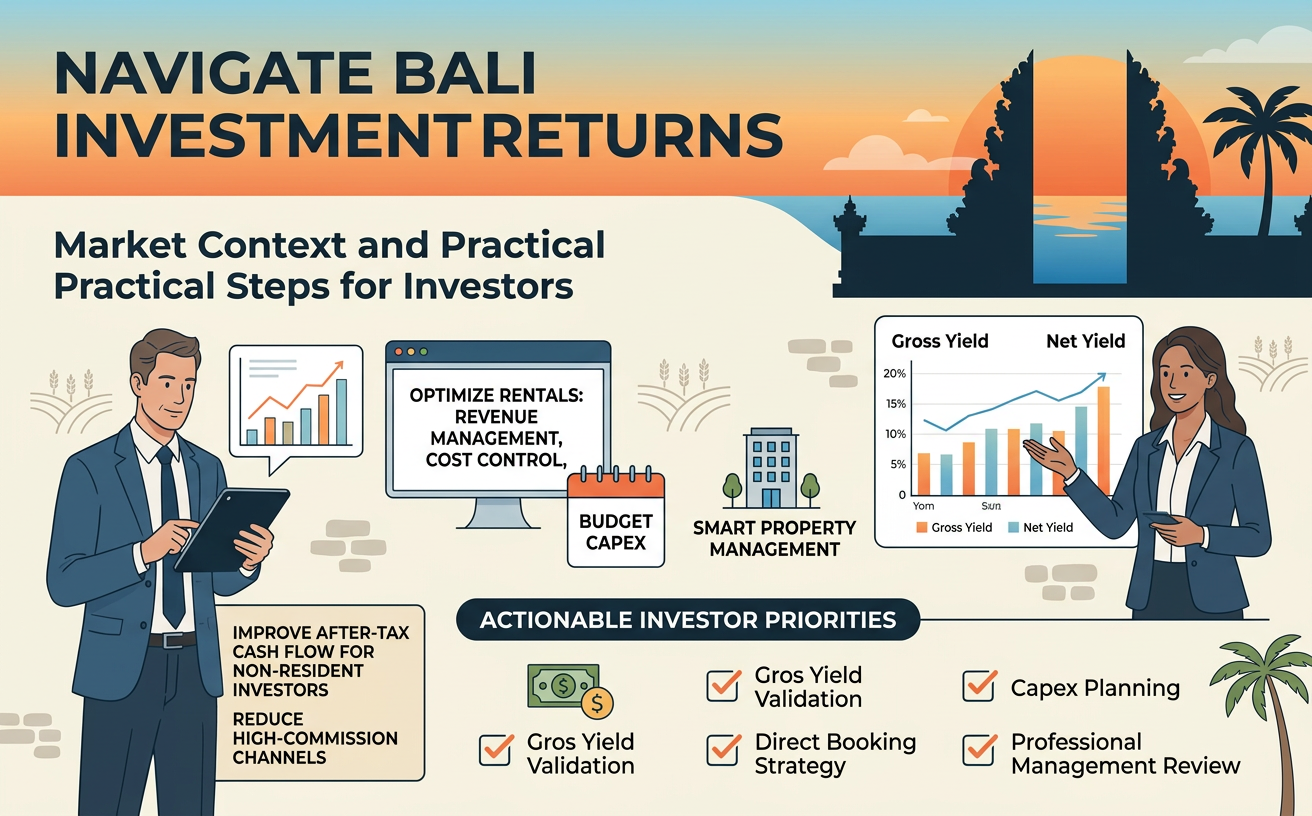
Current macro conditions — from inflationary pressure to shifting travel demand — mean that optimistic historical yield assumptions need recalibration. Price appreciation expectations have softened in many segments, increasing the importance of cash yield and operational excellence for investors relying on rental income. Owners who ignore cost optimization or fail to adopt dynamic pricing risk seeing headline revenue masked by escalating expenses and stagnant net returns.
Practical steps to protect and improve returns include renegotiating distribution mixes to favor direct bookings, implementing revenue management tools, controlling fixed operating costs, and allocating a prudent capex reserve for asset upkeep. Additionally, structuring ownership and tax planning properly can meaningfully affect after-tax cash flow for non-resident investors.
Actionable investor priorities
- Validate gross yield with a line-by-line appraisal
- Reduce reliance on high-commission channels and incentivize direct bookings
- Budget for capex and set realistic occupancy assumptions
- Consider professional management only when it demonstrably improves net yield
Key Takeaways

- 7.1% gross yield on a 6.8B IDR villa (485M IDR) is a useful headline but not a reliable proxy for investor returns.
- Typical deductions — management, OTA fees, taxes, utilities and capex — can materially reduce take-home yield; model these conservatively.
- Professional, market-based appraisals convert gross revenue into investor-level projections and reveal levers to improve net yield.
- Operational improvements and channel mix optimization often deliver larger net yield gains than relying on price appreciation alone.
Final word: headline yields attract attention, but sustainable real estate returns in Bali depend on disciplined cost modeling, market-validated assumptions, and an operational plan that closes the gap between gross revenue and actual investor cash flow. For owners and buyers, the immediate priority is converting optimistic listings into defensible, data-driven projections that reflect real-world expenses and market dynamics.
Jason, Business Journalist at Bukit Vista
You’re a property owner? Wondering What Could Your Bali Villa Really Earn?
Get a data-driven revenue projection based on your property type, area, and bedroom count. Discover your villa’s true earning potential in Bali.