
Life at Bali’s most iconic rice terraces is slowly returning to normal after weeks of protests from local farmers.
In December, local landowners installed dozens of zinc sheets across the landscape to protest against demolition orders issued by the regency government and the potential for large-scale developments to be constructed in the future.

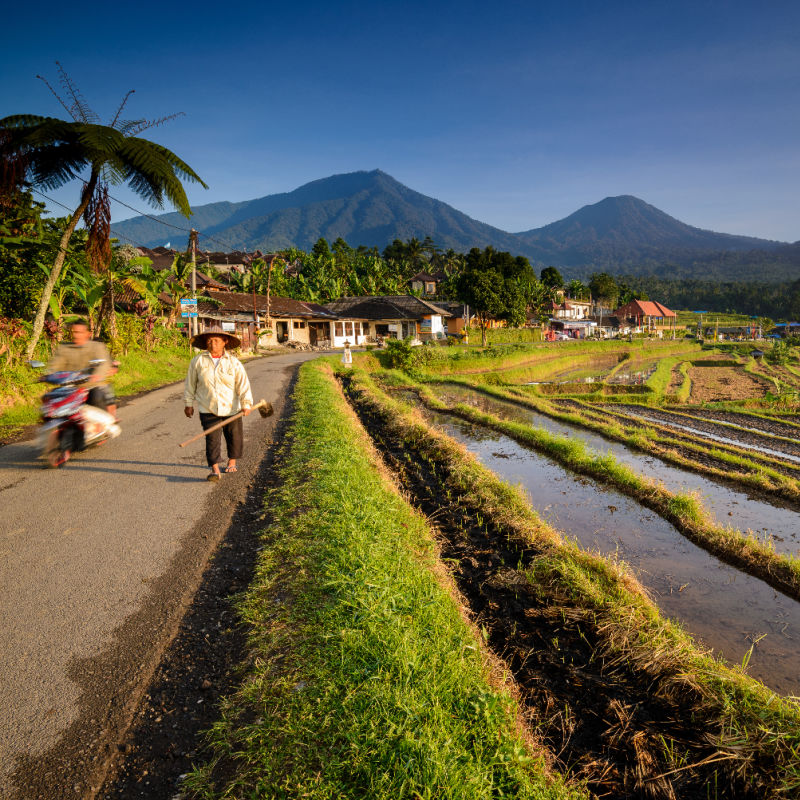
Jatiluwih Rice Terraces in Tabanan Regency are a UNESCO World Heritage Site. Alongside being one of the most popular cultural attractions in Bali, the rice terraces are a vital working agricultural landscape.
Local landowners and farmers installed dozens of corrugated zinc sheets across the rice terraces in protest of the demolition orders for a series of small buildings in the landscape. Many of these buildings were small local warungs or cafes built and owned by local landowners as a way to diversify their income, since rice farming is far from a highly profitable practice most seasons.
The Regency Government issued demotion notices citing that the buildings in question had violated a series of spatial planning laws, despite land owners paying their land and business taxes.
The situation resulted in a sharp drop in the number of visitors to the area, which derives as much income from tourism as from agriculture, sometimes more.
On Monday, 5th January, the Regent of Tabanan, Komang Gede Sanjaya, met personally with farmers and building owners who are accused of violating the green belt laws, and agreed to remove the corrugated iron installed across the landscape.
Regent Sanjaya told reporters, “We, the government, are not standing idly by; we continue to hold meetings to find a solution that satisfies all parties.” He also vowed to protect his community and continue to work collaboratively in a way that upholds the law while safeguarding the livelihoods and well-being of local farmers and business owners.
Regent Sanjaya explained that his personal visit to the Jatilwuih Rice Terraces was a bid to help resolve the issue quickly and personably.
He confirmed that the Bali Regional People’s Representative Council (DPRD)’s Special Committee on Spatial Planning, Assets, and Permits (TRAP) has given the green light for a building moratorium in Jatiluwih.
He confirmed, “There will be building standards, and the TRAP Special Committee will be the one to make the policy. What’s clear is that by early January 2026, the issues in Jatiluwih will be resolved. So everyone will be happy.”

He added that the proposed solutions from the protesting farmers have been listened to and will be integrated into future policies regarding spatial planning, land management, and business development in the area. Regent Sanjaya added, “The farmers’ proposal regarding incentives is a good one. I will be responsible for further discussion with the management body to ensure everything is in order. It will be documented.”
He noted, “I also disagree with having permanent buildings in the middle of rice paddies. What we see in Jatiluwih is rice paddies. If there are too many buildings, tourists might stop coming….Especially now that visits to Jatiluwih have dropped 80 percent. Who’s going to lose out if this continues?”
Speaking separately, Jatiluwih Tourist Attraction Manager Ketut Purna explained, “Tourism has dropped by 80 percent, and Germany and France are no longer selling Jatiluwih.”
Purna has given his assurances that tourists are not only safe to visit Jatiluwih Rice Terraces but are also actively welcomed. The protests from the farmers were always peaceful and posed no threat to visitors. The issue lay in the fact that the zinc sheets ruined the view.
He shared, “We want to ensure that there is no more unrest in Jatiluwih. The situation is conducive, and our focus now is restoring tourist confidence.”

Purna added, “We hope that any future issues can be resolved through a collaborative approach. We are ready to bridge the gap so that they no longer impact Jatiluwih’s tourism image.” He was clear that it may take time for visitor numbers to recover, especially since travel agents book packages long in advance. He noted, “If Jatiluwih is removed from the current package, the impact could be felt for up to a year. Therefore, recovery must be carried out as quickly as possible.”
This means that now is the perfect time for tourists to visit Jatilwuih Rice Terraces. With no crowds, no metal sheets ruining the view, and a little break in the intensity of the rainy season, it sounds like a day trip around Tabanan Regency is in order!
Discover more from The Bali Sun
Subscribe to get the latest posts sent to your email.