
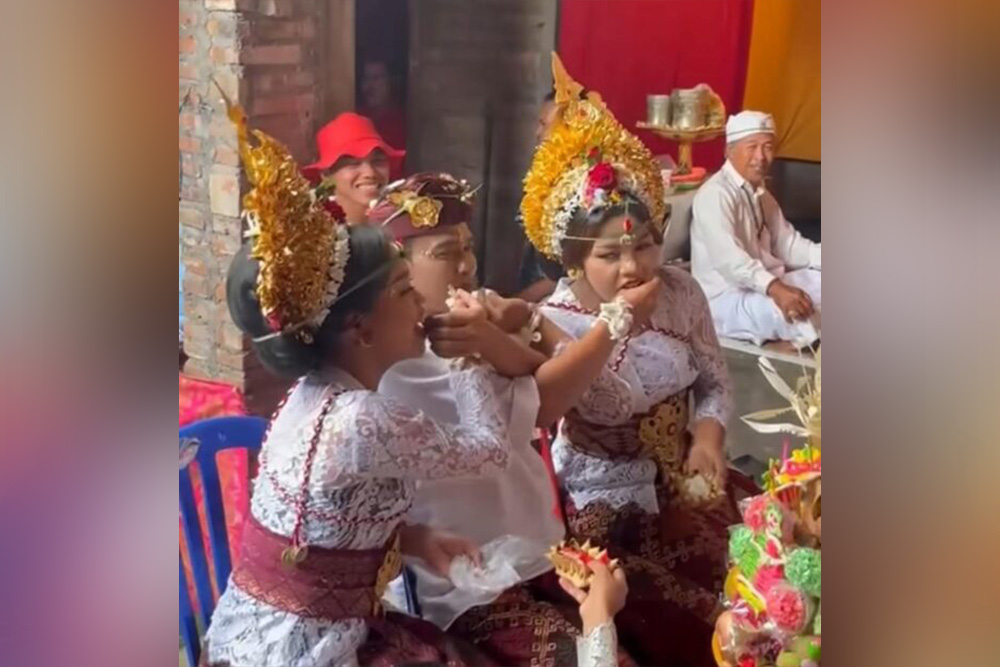
BULELENG, Bali — A wedding ceremony in Bali has gone viral after social media users spotted a groom seated between two women, leading many to believe he was marrying both of them at the same time.
The footage, recorded in Titab Village in Buleleng Regency, quickly spread across Indonesian social media, fueling speculation about polygamy and marriage customs on the island.
But local officials and customary leaders say the reality is far more complicated.
According to village authorities, the man did not marry both women on the same day. Instead, the widely shared ceremony brought together several separate family and customary obligations that had accumulated over time.
A Marriage That Started a Year Earlier
I Wayan Suastika, head of Titab Village, said the man had married the first woman about a year ago. However, not all of the customary ceremonies associated with the marriage had been completed, and the union had not been formally registered with the state.
Several months later, the man entered a relationship with another woman from the village. The woman became pregnant and later gave birth to a child.
When the baby reached three months of age, the family decided to hold a series of ceremonies at the same time. The event included a traditional three-month celebration for the child as well as marriage-related customary rites involving the second woman.
“The child from the second wife had reached three months old, so the family decided to conduct the ceremonies together,” Suastika said.
The resulting images and videos, showing the man seated with both women during the ceremony, quickly attracted attention online.
No Legal Recognition From Village Authorities
Despite the public attention, village officials stressed that they did not issue any documents recognizing the marriages under Indonesian law.
Suastika said local authorities declined to participate in the process because both women were believed to be below Indonesia’s legal minimum marriage age of 19.
“We did not issue any documents,” he said. “When we were asked to witness the marriage, we could not do so.”
Under Indonesian law, both men and women must be at least 19 years old to marry unless a court grants a special exemption.
Village authorities said no official marriage registration was processed through the village administration.
Understanding the Role of Customary Law
Putu Suastika, a customary leader in Titab Village, said the first marriage had taken place roughly a year earlier. Several months later, the man began a relationship with the second woman, who eventually became pregnant.
He explained that the ceremony held on May 31 coincided with the child’s traditional three-month ceremony while also serving as an opportunity to complete customary rites that had been postponed following the first marriage.
According to Putu Suastika, delays were caused by family obligations, including funeral ceremonies and the need to wait for an auspicious day in the Balinese calendar.
“The first wife had already undergone the marriage process earlier,” he said. “Some customary stages had not yet been completed, so they were carried out during the same event.”
He added that he did not attend as a witness because of concerns about the ages of those involved.
Tradition and State Law Are Not Always the Same
The incident has drawn attention to an important distinction in Bali: what is recognized within customary tradition is not necessarily recognized under state law.
According to customary leaders, a marriage may be considered valid within the traditional community after specific rituals have been performed. One such ritual, known as mabiyokaon, is regarded by some customary institutions as formalizing a marriage under customary practice.
However, customary recognition does not automatically carry legal status under Indonesian law.
Village officials reiterated that no official documents were issued in this case and that legal requirements, including minimum age provisions, remain separate from customary traditions.
Putu Suastika also said the second woman is believed to be around 15 years old. He explained that after the pregnancy, the man’s family was expected to take responsibility, leading to the customary ceremony.
Beyond the Social Media Narrative
What appeared online as a simple story of a man marrying two women at once turned out to be something far more complex.
Behind the headlines is a story involving unfinished customary obligations, a child born from a later relationship, questions surrounding underage marriage, and the often misunderstood relationship between Balinese tradition and Indonesian law.
For many outside observers, the episode offers a reminder that viral videos rarely tell the whole story — especially when centuries-old customs and modern legal systems intersect.
Disclaimer: While every effort has been made to ensure accuracy, this article may contain minor inaccuracies
in names, locations, or event details. Readers are welcome to contact the editorial team for any clarification.