
Local hosts and property managers often assume matching neighbor prices is the fastest route to occupancy. We’re unpacking content from Bali Business Review on YouTube to separate myths from measurable revenue strategies, using occupancy, ADR, and market positioning as primary data points.
Hi, I’m Jason, a Business Journalist at Bukit Vista, and I’ll be unpacking analysis from Bali Business Review. Today, we’ll dive into Real Estate Myth: Should You Compete With Neighbors? to offer clear, data-driven insights.
Pricing Strategy vs. Local Competition
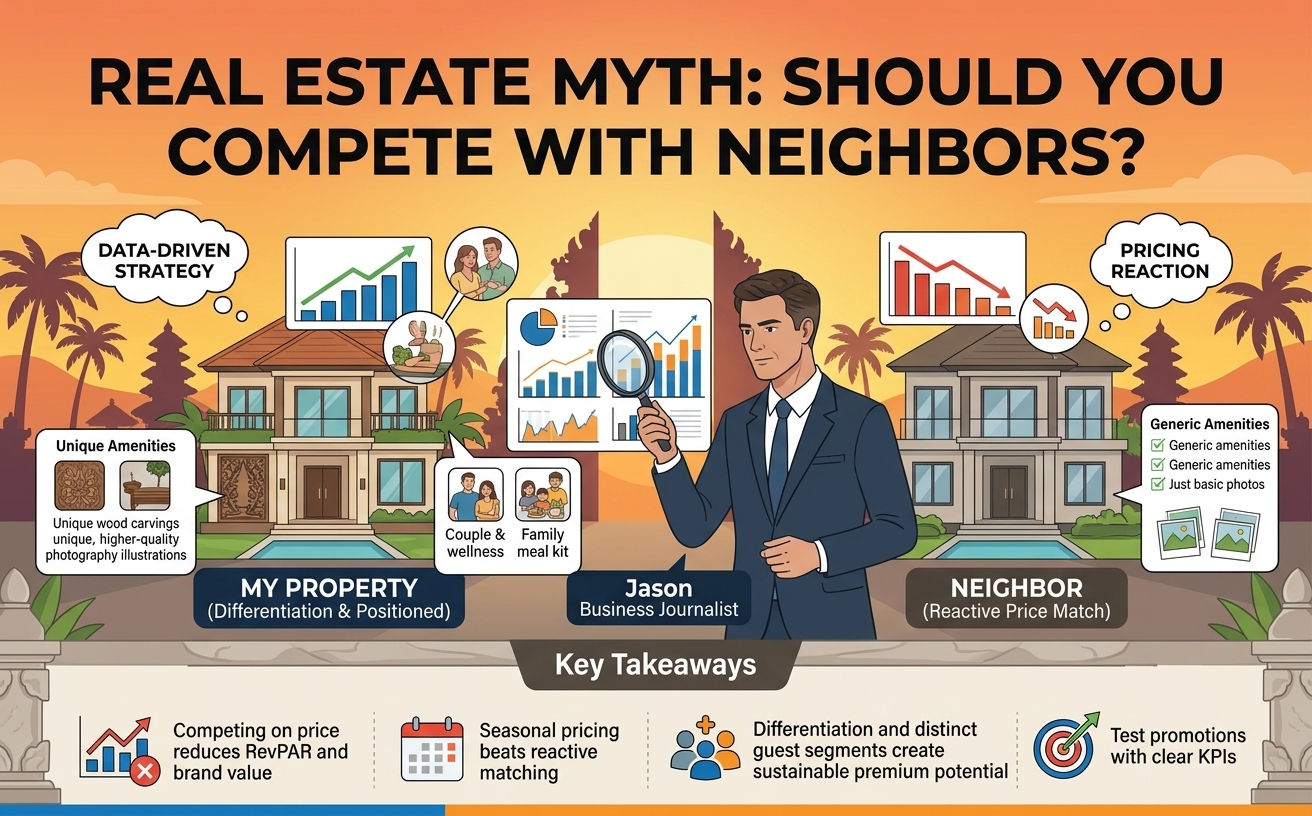
Competing purely on price often erodes long-term revenue. Data indicate lower nightly rates can increase occupancy but diminish average revenue per available rental night (RevPAR) and reduce perceived value. Owners who lower prices without a targeted demand-generation plan risk attracting short-term bargain seekers rather than higher-value guests who book longer stays and return.
Practical checklist
- Map competitor rates by season, not just headline nightly price.
- Model RevPAR and length-of-stay changes before implementing discounts.
- Use promotional windows instead of permanent rate cuts for demand spikes.
Differentiation and Property Positioning
Outperforming neighbors typically relies on differentiation rather than price parity. Investment in unique amenities, higher-quality photography, and clearer guest communication can justify a premium and improve conversion. Positioning also includes targeting distinct guest segments—families, remote workers, wellness travelers—with tailored packages and add-ons that increase ancillary revenue.
Key operational moves
- Audit guest reviews to identify differentiators to highlight in listings.
- Bundle services (airport transfers, meal kits, co-working spaces) to increase ADR.
- Measure cost vs. incremental revenue for each upgrade to maintain margins.
Key Takeaways
- Competing solely on price reduces long-term RevPAR and brand value.
- Data-driven seasonal pricing beats reactive price matching.
- Differentiation and targeted guest segments create sustainable premium potential.
- Test promotions with clear KPIs: occupancy lift, ADR change, and retention.
Final word: owners and managers should focus on measurable positioning and segmented offers rather than mirroring neighbor rates. Practical adjustments to amenities, marketing, and dynamic pricing produce stronger, repeatable revenue gains than price wars.
Source: https://www.youtube.com/embed/eAJTx5rmGdc
Jason, Business Journalist at Bukit Vista