
Most buyers in Bali ask the wrong questions. They ask about the view, the projected yield, the year the villa was built, the walk to the beach. These are reasonable questions. They are also the questions a seller is delighted to answer, because not one of them touches the things that decide whether a purchase is sound.
The questions that matter are the ones buyers rarely know to ask, because nobody on the other side of the table has any reason to raise them. I am going to set down a few things here that parts of my own industry will not thank me for. Lots of people are going to dislike me for telling you this. That is precisely why this column exists. The knowledge that protects a buyer should not be confined to the handful of people who happen to hire us.

Earlier this year we guided a Dubai-based buyer through a purchase of around USD 500,000, paid in cash. He was experienced and careful, and had bought property in three countries before Bali. Every one of the five questions below surfaced in his deal. Not one had been put to him by anyone until we sat down together. None of them was about the property itself.
Whether your broker is properly licensed, and what that licence protects
The first question has nothing to do with the villa. Before you discuss price or projected returns, ask whether the company representing you is a legally established brokerage, and whether the brokers inside it are certified.
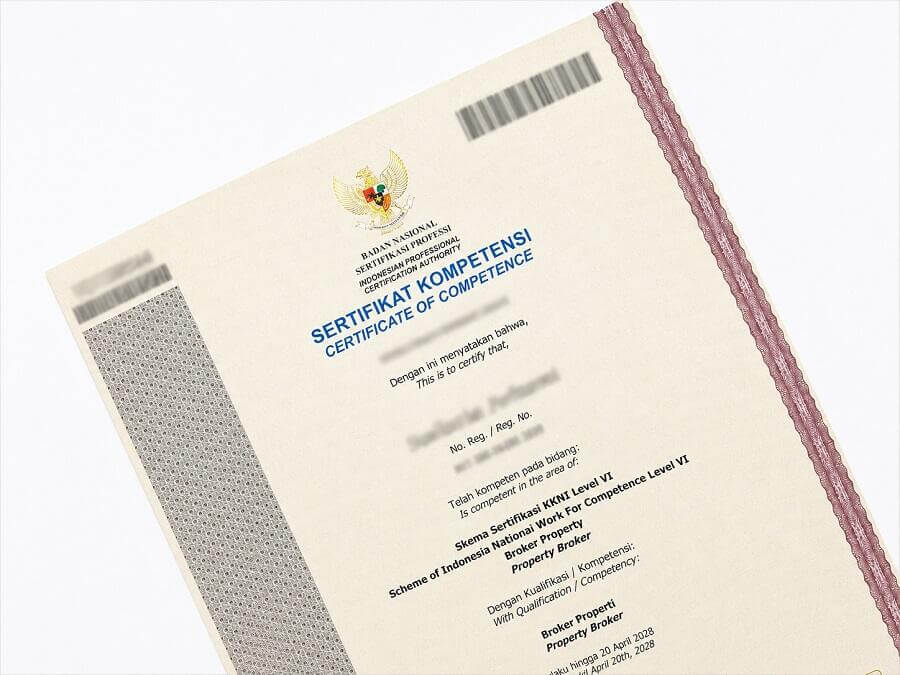
Indonesia’s property brokerage sector is regulated by the Ministry of Trade, and the current framework is Regulation No. 33 of 2025. Michael Hikma Gunawan, Principal of Ray White Kuta and Chairman of DPD AREBI Bali, sets out the standard plainly. Brokerage must be conducted through a properly licensed and registered business entity, the brokers themselves must be Indonesian citizens, and they must hold competency certification issued through the national system overseen by BNSP, the National Professional Certification Agency. That certification confirms a broker has been assessed against the recognised standard for the profession, rather than simply describing themselves as experienced.
That is the legal baseline, and a buyer who confirms those three things has checked what the law actually asks for. Beyond it sits AREBI, the Asosiasi Real Estate Broker Indonesia, the national brokers’ association, which does essential work on professional standards, ethics, and education. As Michael frames it, membership adds a further layer of professional oversight on top of the legal requirements, and I will come to why that matters in a separate piece.
This matters more in 2026 than it did a year ago, because the framework now puts real weight on corporate accountability and consumer protection. Property brokerage is no longer treated as an informal activity that anyone can carry out alone, without a business structure or a credential. A foreign individual, it is worth adding, cannot work as a licensed broker here at all, since certification is reserved for Indonesian citizens.
The reason to care is accountability. When a transaction runs through a properly established company employing certified brokers, there is an identifiable entity, documented standards, named responsible parties, and a formal channel for raising a dispute. When it runs through an unlicensed operator working alone, there is none of that. They can change their number, block you, and leave you to carry the problem yourself. I am not saying independent agents are dishonest. Many are good people who care about their clients, and their character is not the issue. The issue is that when a deal worth hundreds of thousands of dollars turns, good intentions are not a route to recourse. A regulated structure is.
None of this should feel foreign. In Australia, Hong Kong, Singapore, the United Kingdom, and the United States, buyers are urged to work with licensed businesses and qualified professionals, and to take a complaint to a regulator when something goes wrong. Indonesia is moving firmly in the same direction. Your task is to confirm that the people you are trusting already sit inside that framework.
Licensing is the floor, though, not a guarantee. It does not replace proper legal due diligence, independent verification of the ownership documents, or secure handling of your deposit. It tells you who you are dealing with. The next four questions are about what to check once you know.
What is actually included in the asking price
The second question is blunt. Ask whether the quoted price includes tax, and which taxes apply to your specific transaction.
On a standard resale between two private individuals, value added tax does not arise. Buy from a developer or a business seller registered to collect VAT, and the position changes. VAT of 11 percent applies, and it is the buyer who carries it. More than one buyer has discovered that an attractive off-plan number was the figure before tax, with 11 percent waiting quietly at signing. There is relief worth knowing about. Through 2026 the government is covering VAT on the portion of a new landed house or apartment priced up to IDR 2 billion, available to qualifying foreign buyers. Ask whether your purchase falls inside that window.
Then there is the baseline, so you know what is normal. The acquisition duty, BPHTB, runs to 5 percent and falls to the buyer. The seller’s transfer tax, PPh, is 2.5 percent and falls to the seller. Those are the conventions. So when a seller tries to slide their 2.5 percent across the table to you, you will recognise it for what it is. A negotiation, not a rule.
The seller’s plan for the declared value, and why it becomes yours
This is the most common arrangement in the market, and the most quietly dangerous. A seller, sometimes through the agent, proposes that the value declared to the tax office and the land office be set well below the real price, often close to the government’s assessed NJOP figure. It shrinks the seller’s tax. It shrinks your acquisition duty today. It is presented as a shared saving.
It is nothing of the sort. The declared figure goes onto the deed in your name. Coretax, Indonesia’s integrated tax system, now cross-references declared values automatically, and it is built to flag exactly this kind of gap. The buyer who agreed to a convenient number is the one left holding a deed that understates what they paid, and the one exposed if that number is ever questioned. We advise against it without exception. We also raise it before any letter of intent or deposit, never after, because you have the right to understand the seller’s tax intentions from the first serious conversation. It is one of the things we settle before a property is ever placed on our verified list.
Why a zoning colour is not a green light
Buyers learn the colours fast. Green, yellow, pink, red. Then they assume the colour settles the matter. It does not. A zone is where the enquiry begins, and inside it sit conditions that decide what you can actually do with the land.
Two documents matter more than the colour. The ITR, the spatial-planning information, is what you check with the local public works office before you sign anything. The PKKPR, the approval of suitability for spatial use, is the confirmation issued through the OSS system that your specific intended activity is permitted on that exact plot. Without it, a project cannot lawfully obtain its building approval. Land falls under the authority of ATR/BPN, the national land agency, and the detailed rules are set region by region, so what holds in Badung may not hold in Tabanan, Gianyar, or Buleleng.
Two traps deserve naming. Not all green land can be built on, and protected green zones will see a permit refused outright. And the right to build is not the right to operate. If you intend to run a rental business, the land and the licence must support the appropriate KBLI business classification, or you may build a villa you are not permitted to let. How much of a plot may be built on, and to what height, is governed by separate ratios again. Ask the seller for the ITR. Ask whether a PKKPR can be secured for what you actually intend to do, not for what the land vaguely allows.
Whether you may appoint your own notary and legal team
The last question tells you almost everything. Ask whether you are free to appoint your own notary, and your own legal and tax advisers, to run independent due diligence.
A seller who insists that you use their notary is waving a flag, however pleasantly they do it. The reasons always sound helpful. It will be faster. The due diligence is already done. The notary holds all the paperwork. We have done many of these without a problem. Sometimes every word of that is true. But of the small number of deals in the past three years where a seller pressed us hard to use their notary alone, our independent legal and tax partner found material issues that had not been disclosed. Not every such deal hides a problem. The point is that you cannot know which is which without your own set of eyes on the file.
If you love the property, you do not have to walk away. You appoint independent advisers to run a second review in parallel, and you proceed on what they confirm. On a USD 500,000 cash purchase, the cost of that second opinion is a rounding error against the price of being wrong. It is the best money a buyer can spend in this market.
The point of asking
These are five of the questions we work through before a single property earns a place on our verified list, and there are more behind them. We ask them because our fee is paid by the buyer, directly, which means our task is to establish whether a property is sound, not to move whichever one happens to carry the largest commission. That arrangement is still uncommon in Bali, and saying so plainly tends to irritate people who prefer the older way of working.
I can live with that. This column exists so the knowledge is not the private property of our clients. Ask these five questions of anyone who wants to sell you a Bali property. The way they answer, and how quickly, will tell you most of what you need to know, long before the deposit ever leaves your account.