

In Bali, even animals considered agricultural pests can become part of a sacred ritual.
On the island where elaborate cremation ceremonies are traditionally held to honor the dead, an unusual version of the practice involves an unlikely subject: rats.
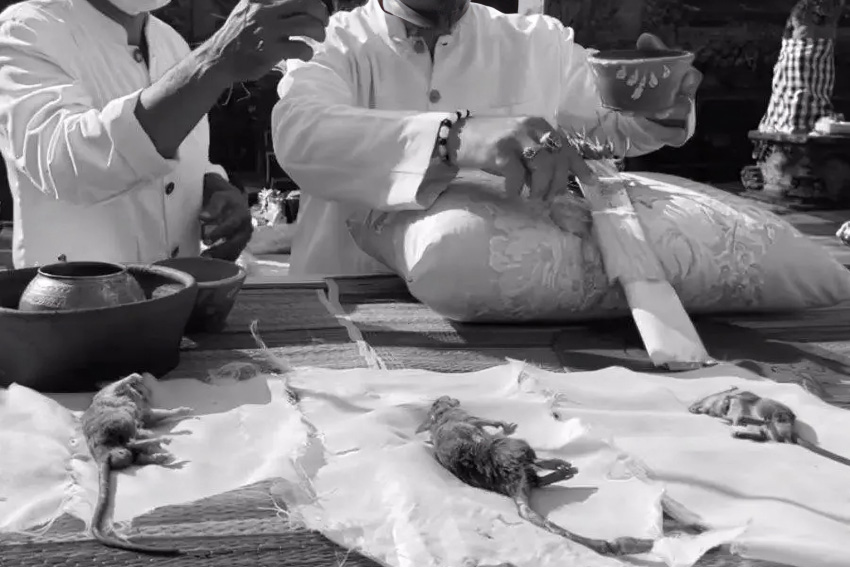
Known as Ngaben Tikus, or Ngaben Bikul in Balinese, the ceremony reflects a distinctive aspect of Balinese Hindu culture, where maintaining harmony with nature is considered just as important as protecting the land that sustains local communities.
The tradition was brought into focus again on November 9, 2026, when farmers, religious figures and local officials gathered at Seseh Beach in Badung regency to perform Ngaben Tikus alongside a purification ritual known as Pemahayu Jagat.
But why would a community struggling with rats destroying its crops hold a cremation ceremony for the very animals causing the damage?
More Than Just Pest Control
For generations, rice farming in Bali has been closely connected to religious beliefs and traditional ceremonies.
Rats can pose a serious threat to rice crops, damaging fields and affecting farmers’ livelihoods. While conventional pest-control measures remain necessary, Balinese communities have also developed rituals that address agricultural problems through a spiritual understanding of the natural world.
Ngaben Tikus is one such tradition.
Before the ceremony, rats are collected from agricultural areas through an activity locally known as ngropyok, a coordinated effort to catch rodents that threaten crops.
The collected animals are then incorporated into a cremation ritual intended to restore balance and seek protection for farmland.
Unlike ordinary pest control, however, the ceremony is not simply about eliminating unwanted animals.
It reflects a belief that humans, animals and the environment are interconnected, and that harmony should be maintained even when their interests come into conflict.
The Spiritual Meaning Behind the Ritual
In Balinese Hindu philosophy, life is understood through both sekala, the visible physical world, and niskala, the unseen spiritual dimension.
For farmers, protecting rice fields therefore involves more than practical agricultural techniques. Rituals, offerings and prayers are also part of maintaining a harmonious relationship with the environment.
Ngaben Tikus expresses that relationship through a ceremony that may seem surprising to visitors unfamiliar with Balinese traditions.
The rats are regarded not merely as destructive pests but as living creatures within a wider spiritual order.
Through the ritual, participants seek blessings for healthy crops, protection from infestations and the restoration of balance between people and nature.
The accompanying Pemahayu Jagat ceremony similarly focuses on prayers for harmony and the well-being of the surrounding environment.
These practices are expressions of religious belief and cultural heritage, rather than scientifically established methods of controlling rodent populations.
A Tradition Connected to Bali’s Rice Fields
The ceremony at Seseh Beach was organized by the Badung Regency Government, with the participation of traditional agricultural communities.
Badung Regent I Wayan Adi Arnawa said the event marked the third time the local government had organized Ngaben Tikus as part of its efforts to support farmers and preserve local traditions.
Representatives of Bali’s subak organizations also took part.
Subak is the island’s traditional agricultural irrigation and management system, in which farming practices are closely tied to communal cooperation, religious observances and the surrounding landscape.
The involvement of pekaseh, or subak leaders, underscored the relationship between the ceremony and the everyday challenges faced by farming communities.
Local authorities emphasized that spiritual observances are accompanied by practical agricultural measures, including pest-management programs carried out with farmers.
For visitors, Ngaben Tikus offers a window into a side of Balinese culture rarely seen in conventional tourism imagery.
Beyond temples, dances and elaborate offerings, it reveals how deeply traditional beliefs remain woven into ordinary life, including the struggle to protect a rice harvest.
In Bali, even a ceremony for rats can tell a much larger story about the relationship between people, spirituality and the natural world.
Disclaimer: While every effort has been made to ensure accuracy, this article may contain minor inaccuracies
in names, locations, or event details. Readers are welcome to contact the editorial team for any clarification.