

Bali has lost 6,522 hectares of productive rice field since 2019. The province’s registered paddy baseline stood at 70,996 hectares that year; by February 2026 it had fallen to 64,474 hectares, a conversion rate of roughly 1,254 hectares every year, much of it absorbed by villas, commercial buildings, and tourism infrastructure. On 24 February 2026, Governor Wayan Koster signed the regulation designed to stop it. Regional Regulation No. 4 of 2026 on the Control of Productive Land Conversion and the Prohibition of Nominee Land Ownership does two things at once: it protects what remains of Bali’s agricultural land with criminal exposure attached, and in doing so, it quietly redraws the supply map for everyone who buys property here.
Most of the coverage since February has focused on the nominee half of the regulation. That is understandable, and we will come to it. But for buyers, the more consequential half is the one almost nobody is writing about: the land itself.
What the Regulation Actually Does
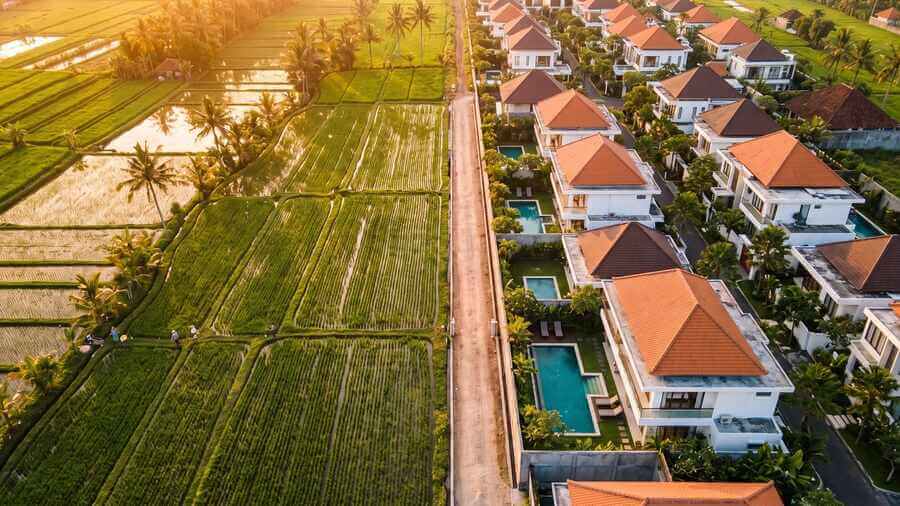
Perda 4/2026 places Bali’s remaining productive agricultural land, covering food crops, horticulture, and plantation land, under a control regime for conversion to other uses. The centrepiece is a freeze: the provincial government has suspended conversion permits across the remaining rice field stock until 87% of it is permanently designated as sustainable food agriculture land, known as LP2B. The Governor has instructed every regent and mayor across the island to tighten the issuance of building permits on productive land accordingly.
The regulation carries weight because of what sits behind it. It aligns with Law No. 41 of 2009 on the Protection of Sustainable Food Agriculture Land, under which illegal conversion of protected agricultural land carries penalties of up to five years’ imprisonment and fines of up to IDR 1 billion, and with the national spatial planning framework, where violations carry up to three years and fines of up to IDR 500 million. Administrative consequences run alongside: permit cancellation, fines, revocation of fiscal incentives, and the obligation to demolish non-compliant structures and restore the land to its original function.
Converting a rice field into a villa in Bali is no longer a paperwork problem. It is a criminal one.
There is a constructive side to the regulation that deserves more attention than it has received. Farmers who keep productive land in agricultural use are offered land and building tax relief of up to 100%, subsidised seed and fertiliser, and investment in irrigation infrastructure. The province is not only punishing conversion. It is paying people not to convert.
The Nominee Prohibition, Briefly
The same regulation formally prohibits nominee land ownership, the arrangement in which land is registered under an Indonesian citizen’s name whilst a foreign party funds the purchase and controls the asset through side agreements. Nominee structures have always been void under Article 26(2) of the Basic Agrarian Law; what Perda 4/2026 adds is provincial enforcement with criminal exposure, and it explicitly extends that exposure to intermediaries and facilitators, the people who arrange these structures, not only the parties to them. If anyone still needed a reason to use the legal routes, leasehold, Hak Pakai, or a properly structured company holding building rights, this is it.
Why This Redraws the Supply Map
Here is the arithmetic the market has not fully priced. Bali’s most sought-after corridors, Canggu, Pererenan, Kedungu, Seseh, and the belts around Ubud, grew by building into exactly the land this regulation now protects. The rice field view that sells the villa was, in many cases, the next development site. Freeze conversion permits across the remaining paddy stock, and the pipeline of new developable land in those corridors contracts sharply.
Constrained supply changes behaviour on both sides of the market. Land that already sits in correctly zoned, legally developable areas becomes scarcer and more valuable. Projects that secured their permits lawfully before the freeze hold an asset that is now harder to replicate. And at the margins, pressure builds on developers who cut corners, because the route they might once have taken, acquire agricultural land cheaply and regularise it later, has been closed with criminal consequences attached.
The investment data suggests the market understands which way this points. The Indonesian Real Estate Association reported around IDR 12.1 trillion of property investment in Bali in 2026, roughly 10% of the national total, announced in the same period these rules took effect. Capital is not fleeing the regulation. It is repricing certainty, and certainty now lives on the compliant side of the line.
What Buyers Should Do Differently
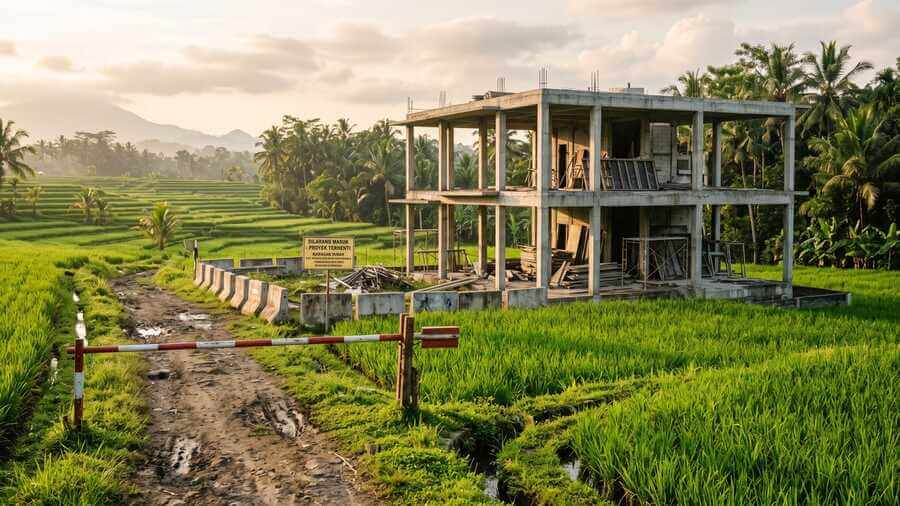
The practical consequence is that zoning verification has moved from a due diligence footnote to the first question that decides whether a purchase should proceed at all. And it comes with a twist worth understanding: the most important zoning map in Bali right now is the one that has not been published yet. Until the permanent LP2B designation is finalised, the freeze governs, which means the paperwork behind a specific parcel matters more than any map, brochure, or assurance in front of it.
For land buyers, the question is no longer only what the zoning certificate says today, but whether the parcel touches protected agricultural designations, and whether any conversion history in the chain of title was completed lawfully. In our own buyer-side work at Fullers Properties, conversion history has moved to the front of every land brief this year, checked before a client views a single parcel, because a plot with an unresolved conversion in its past is a plot carrying someone else’s criminal exposure.
For off-plan buyers, the question is whether the project’s building approvals were issued on land that was legally developable at the time, with the permit trail to prove it. A render tells you nothing about this. The permit file tells you everything. Under the current regime, a project built on improperly converted land does not face a fine and a delay; it faces demolition and restoration orders.
For villa buyers in the established corridors, the freeze cuts both ways. It supports the value of compliant stock by constraining future supply, and it raises the cost of getting verification wrong, because the enforcement environment surrounding this regulation is not theoretical. The same government that froze farmland conversion moved against unlicensed accommodation this month, with around 1,600 unlicensed properties identified for removal from online booking platforms from 1 August. Enforcement in Bali in 2026 is not a single regulation. It is a direction of travel.
A Smaller Map, a Clearer One
Bali is not running out of property. It is running out of tolerance for property that should never have been built. Perda 4/2026 shrinks the theoretical supply map and enlarges the premium on the part of it that was always legal, and for buyers willing to verify before they commit, that is a better market, not a worse one.
“Bali is not closed. The shortcut is closed,” says Adv. Surya Dharma SH., CPL., Director of 4 Pillars Consulting. “These regulations separate serious, long-term investors from speculators, and that builds a better economy for locals and foreigners alike. There is a silver lining that is easy to miss: demand for tourism and its supporting businesses remains high whilst supply cannot expand, so those who have already invested compliantly face no new competition.”
That is the reading the market data supports. Fewer hectares. Fewer shortcuts. A clearer line between the properties that will hold their value and the ones that were only ever as solid as the paperwork behind them.
For international buyers, the lesson of 2026 keeps repeating itself in different forms. The question is never whether Bali remains worth buying into. It is whether the specific parcel, the specific project, and the specific structure in front of you can survive scrutiny in a market that has started scrutinising. Independent verification, before any deposit moves, is how you find out.